Editor’s note
From the Karakum
In the autumn of 1948, Soviet archaeologists working at Old Nisa, the Parthian royal seat in the foothills outside Ashgabat, found a set of carved ivory drinking horns, rhytons, laid on a bench in the building now called the Square House. Encyclopaedia Iranica dates them most probably to the second or first century BCE and says their friezes show the twelve Olympian gods and Dionysiac sacrificial scenes, made for ceremonies, banquets and libations. The museums that hold them count them differently: the Pushkin Museum gives 42, and the Turkmen state portal says nearly 50. Either way, people on this ground were hosting long before October 2026, when Awaza held three summits in two days, and long before a clothing brand put a dutar on a festival poster in Ashgabat, the two kinds of hosting this edition covers. (Iranica, "Nisa")
The Lead
Awaza week: three summits in two days and a new council with Uzbekistan
Context. Turkmenistan holds the rotating chairmanship of the CIS in 2026, the year of the Commonwealth's 35th anniversary, and in July, it joined the Central Asian treaty on friendship, good-neighborliness and cooperation for the 21st century. On 29 September, Turkmenistan used its statement to the 81st UN General Assembly to propose a transregional transport corridor under UN auspices, linking South and Central Asia with Europe across the Caspian, and an international code for the peaceful use of artificial intelligence in diplomacy. Both proposals had first been announced at a Cabinet meeting in July, and in October, Turkmenistan moved from proposing to hosting.
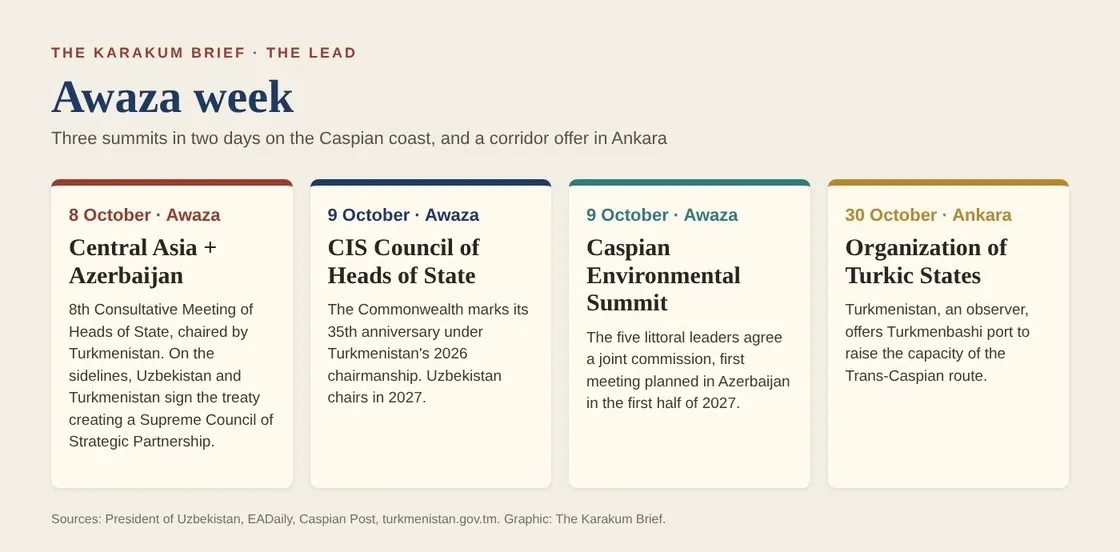
Observation. On 8 October, President Serdar Berdimuhamedov chaired the 8th Consultative Meeting of the Heads of State of Central Asia and Azerbaijan at Awaza, the first formal summit since Azerbaijan became a full participant in November 2025. The six leaders signed a joint statement and a decision on the format's founding documents, and Shavkat Mirziyoyev proposed a regional Council on Infrastructure Development and a business forum in Khiva in 2027 (President of Uzbekistan, Russian). On the sidelines, Mirziyoyev and Berdimuhamedov signed a treaty creating a Supreme Council of Strategic Partnership (Russian) between their two countries and called for a plan to multiply bilateral trade, which stood at US$1.15 billion in 2024 against a US$2 billion target set in August 2025. On 9 October, Awaza hosted the CIS Council of Heads of State, which adopted a joint statement on the CIS founding documents and amendments to its agreement on IT crimes (EADaily, Russian). The same day, the five Caspian leaders met at a Caspian Environmental Summit, a Turkmen initiative, and agreed to set up a joint commission whose first meeting is planned in Azerbaijan in the first half of 2027. Ilham Aliyev told the meeting that the sea had shrunk by more than 20,000 square kilometers.
Analysis. Three formats in two days put Vladimir Putin, Masoud Pezeshkian, Ilham Aliyev, Kassym-Jomart Tokayev, Shavkat Mirziyoyev, Sadyr Japarov and Emomali Rahmon on the Caspian coast at Turkmenistan's invitation. My reading of the week is a neutral state using its chair to build standing mechanisms. Two new bodies came out of it, the Uzbek council and the Caspian commission, and the commission already has a half-year set for its first meeting. The connectivity message stayed the same across venues. At the Organization of Turkic States summit in Ankara on 30 October, Berdimuhamedov said Turkmenistan considers it important to raise the capacity of the Trans-Caspian International Transport Route ("Hazarüsti halkara ulag geçelgesiniň kuwwatyny artdyrmagy möhüm hasaplaýarys") and offered the infrastructure of Turkmenbashi port toward it (turkmenistan.gov.tm, Turkmen).
So what. For anyone working on the region, Awaza is now a place where regional formats meet, and Turkmenbashi is the asset Ashgabat puts forward in every corridor conversation. Uzbekistan takes the CIS chair in 2027 with Turkmenistan as a co-chair, and the next CIS summit is set for Bukhara in October 2027, so the agenda set at Awaza carries into next year.
What this doesn't tell us yet. The Supreme Council has no published membership, schedule or first meeting date, and the trade plan has no figure or deadline beyond the 2025 target. I could not find the text of a Caspian declaration, and the UN corridor and AI code proposals have no draft resolution yet. The World Bank's estimate that the Trans-Caspian route needs at least US$25 billion in infrastructure by 2040 shows the size of the gap between offering a port and filling a corridor.
The Blotter
Turkmenistan Blotter
Turkmenistan proposes a UN-backed transport corridor.
In the general debate of the 81st UN General Assembly, Permanent Representative Vepa Hajiyev proposed a transregional corridor under UN auspices linking South and Central Asia with Europe across the Caspian, a Global Atlas of Sustainable Transport Connectivity and a UN-backed center for trade logistics and customs cooperation in Turkmenistan.
The EBRD expects its first Turkmen deals from the Central Bank memorandum.
Eric Livny, the bank's Head of Turkmenistan, told Trend that the memorandum signed with the Central Bank in July is "the most immediate and practical" of five, because it lets the EBRD lend directly again to export-oriented private firms with their own currency earnings. Since 1992, the bank has financed 87 projects in Turkmenistan worth €322 million.
Kazakhstan and Turkmenistan set up a permanent media council.
The Kazakh President's TV and Radio Complex and Turkmenistan's State Committee for Television, Radio Broadcasting and Cinematography signed the agreement on the Awaza summit sidelines. Kazakhstan's Silk Way and Silk Way Cinema channels are expected to launch in Turkmenistan.
Ashgabat opens three specialized medical centers.
On Healthcare Workers' Day, President Serdar Berdimuhamedov opened an international oncology center with 500 places, the country's first bone marrow transplant unit and its first palliative unit, a dental center with 80 places and an international pediatrics center with 160. More oncology centers are planned for Balkan, Lebap and Mary.
OSCE course on humanitarian law for Turkmen law students.
Fifty students and faculty from the International University for the Humanities and Development, the Foreign Ministry's Institute of International Relations and the Interior Ministry's institute studied human rights law, international humanitarian law and refugee law with experts from Austria.
Turkmen officials study methane monitoring in the UK.
The delegation visited London, Aberdeen, Peterhead and Teesside, met GHGSat, BP and the Royal Holloway greenhouse gas group and toured Shell's St Fergus terminal, with a focus on how the EU Methane Regulation applies to imports. The visit ran under an EU and German project implemented by GIZ.
Two white tiger cubs are born at the Ashgabat Zoo.
The male and female cubs of Taymaz and Narin will go on public view in spring 2027 at the zoo, formally the National Museum of Wildlife, which opened in 1932 and sits on about 40 hectares on the Kopet Dag slopes.
Ashgabat proposes an international code for the peaceful use of AI.
At the 7th CICA Summit in Baku, President Serdar Berdimuhamedov proposed an International Code for the Peaceful Use of Artificial Intelligence in International Relations and Diplomacy, saying its use requires "a responsible approach based on international law, trust" and the interests of all states.
OGT 2026 draws 1,700 delegates to Ashgabat.
The 31st Oil and Gas of Turkmenistan forum brought delegates from about 450 companies in 75 countries, and five documents were signed with partners from China, Malaysia, Kazakhstan and Uzbekistan. At a Türkmengaz and CNPC session, the sides put cumulative gas deliveries to China since December 2009 at more than 477 bcm.
Berdimuhamedov offers Turkmenbashi to the Turkic states.
At the 13th Organization of Turkic States summit in Ankara, where Turkmenistan is an observer, the president offered the port to expand trans-Caspian transit. Euronews reported Middle Corridor freight up 30 percent and transit up 90 percent in the first nine months of the year. A day later, at a forum in Ankara, Binali Yıldırım of the OTS Council of Elders called for joint factories along the corridor.
The Watch
Caspian & Central Asia Watch
India says it has sold Akash air defense systems to Tajikistan and Turkmenistan.
Defence Secretary Rajesh Kumar Singh confirmed the sales in an interview with ANI. The DRDO-built system reaches 4.5 to 25 km in range and up to 20 km in altitude, according to India's Defence Ministry, and no value or quantity was disclosed. Neither the Tajik nor the Turkmen government had commented by early October, so the claim rests on the Indian side. Armenia was the first export customer, in 2022.
Iranian fuel starts reaching Tajikistan.
Shipments began in late August, Tajikistan's Energy and Water Resources Ministry told Asia-Plus, after Russia, which supplied more than 91 percent of Tajikistan's petroleum-product imports in the first half of 2026, restricted exports. Dushanbe has asked for up to 2.55 million tonnes a year, a requested figure with no confirmed deliveries behind it. A US Treasury official warned that anyone in the sector "incurs that risk themselves." Analyst Frederic Schneider told Al Jazeera the product would have to cross Turkmenistan and Uzbekistan by rail.
Central Asia leaves the Asian Games with 186 medals.
The Aichi-Nagoya Games ran from 19 September to 4 October. Uzbekistan finished fifth with 21 gold and 70 medals in all, Kazakhstan eighth with 12 gold and 84 medals, Tajikistan set a national record with 16 medals, and Kyrgyzstan won 14. Turkmenistan took two silvers: Davut Nazmyradov in karate at 75 kg, beaten 3:4 in the final by Iran's Morteza Nemati, and Shahzadbek Matyakubov in weightlifting at 110 kg.
The region's water ministers meet in Avaza.
The 95th meeting of the Interstate Commission for Water Coordination brought together the water chiefs of Kazakhstan, Tajikistan, Turkmenistan and Uzbekistan the day before the Avaza summit, with Durdy Genjiyev, chairman of Turkmenistan's State Committee for Water Management, at the table. The agenda covered reservoir limits on the Syr Darya and Amu Darya in the 2026 growing season, withdrawal limits and the reservoir operating plan for the 2026 to 2027 non-growing season. The secretariat's report lists no decisions.
"Himoya" opens at Tselinny in Almaty.
Curated by Natasha Ginwala, the exhibition brings together 21 artists and thinkers on matrilineal memory and runs until 4 April 2027. Aziza Kadyri's "Iron Mother" is built around her grandmother Umida, who helped oversee construction of the Tashkent TV Tower and became its first director.
Dushanbe celebrates Mehrgon.
Each region set up its own exhibition in Firdawsi Park, and Khatlon laid a long dastarkhan. The harvest festival was revived in 2009, entered Tajikistan's national heritage list in 2017 and was inscribed by UNESCO, jointly with Iran, in December 2024.
The C5+1 ministers meet in Samarkand, and Uzbekistan announces US$12 billion in US deals.
The Samarkand meeting covered trade, transport, energy, digital infrastructure and critical minerals, and set out to link the C5+1 with its business track, the B5+1. Secretary of State Marco Rubio's visit also produced 54 trade, investment and technology agreements with GE Aerospace, Wabtec, Trafigura, BlackRock and others, which the Uzbek government says "would total $12 billion upon implementation." The total is a potential value, and neither source says how many agreements are binding.
Kazakhstan puts its investment in Tajikistan at more than US$148 million.
Ambassador Valikhan Turekhanov gave the figure, with no period attached, at a Republic Day reception in Dushanbe. Trade reached US$1.13 billion in January to September 2026, and wheat led Kazakh exports at about 998,200 tonnes worth US$264.1 million.
A Kyrgyz grocer looks to Kazakhstan.
Rud Pedersen, who chairs the supervisory board of Umai Holding, Kyrgyzstan's largest grocery retailer, told ESM Magazine that Umai proposes to buy Kazakhstan's Vkusnaya Korzinka and its 49 supermarkets, which would take the network to 221 stores. He puts the combined Kazakh and Kyrgyz grocery market at US$24 billion today and about US$45 billion by 2036.
Deep Dive
Monthly Deep Dive
Däp means tradition: a modern toý, a garden café and Turkmenistan on Instagram
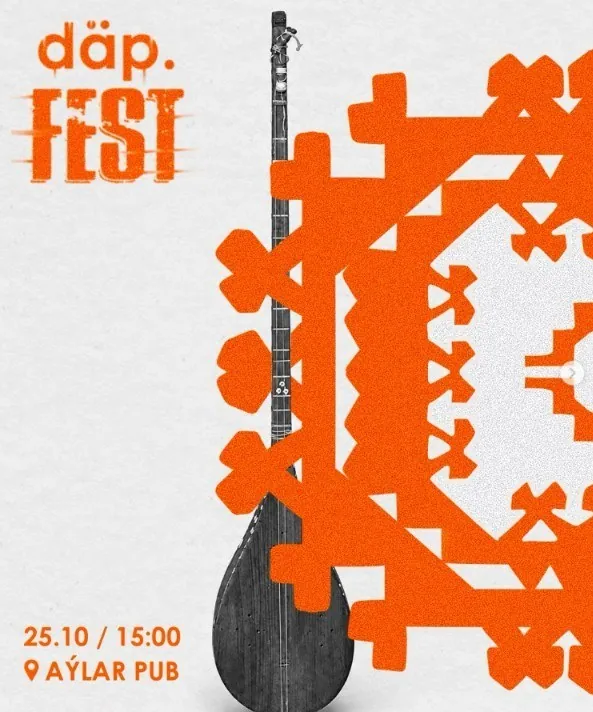
On 25 October at 15:00, the Turkmen clothing brand DÄP opened the gates of Aýlar Cafe in Ashgabat to a "modern Turkmen toý," a wedding feast staged as a festival, with tickets at 200 manat. Each guest drew a bead at the entrance, and the bead decided what role that guest would play at the wedding. The brand's announcement on Instagram promised live music and a DJ set, performers, an opening with hosts and musicians, team games and sports contests, gifts from partners, an auction of a painting made by an artist during the festival, a children's zone, a market, photo spots and a closing dance flashmob in which everyone took part. Afterwards, DÄP thanked its guests, sponsors, partners, volunteers, decorators and the management of Aýlar, and wrote (in Russian) that the day was "much more than just an event," a matter of people, music, dancing and moments worth keeping. Däp is the Turkmen word for custom or tradition, and most coverage of Turkmenistan stays with gas volumes and white-marble boulevards, so this month the Deep Dive goes to what young people in Ashgabat are building for each other and how closely it tracks what their peers are doing elsewhere.
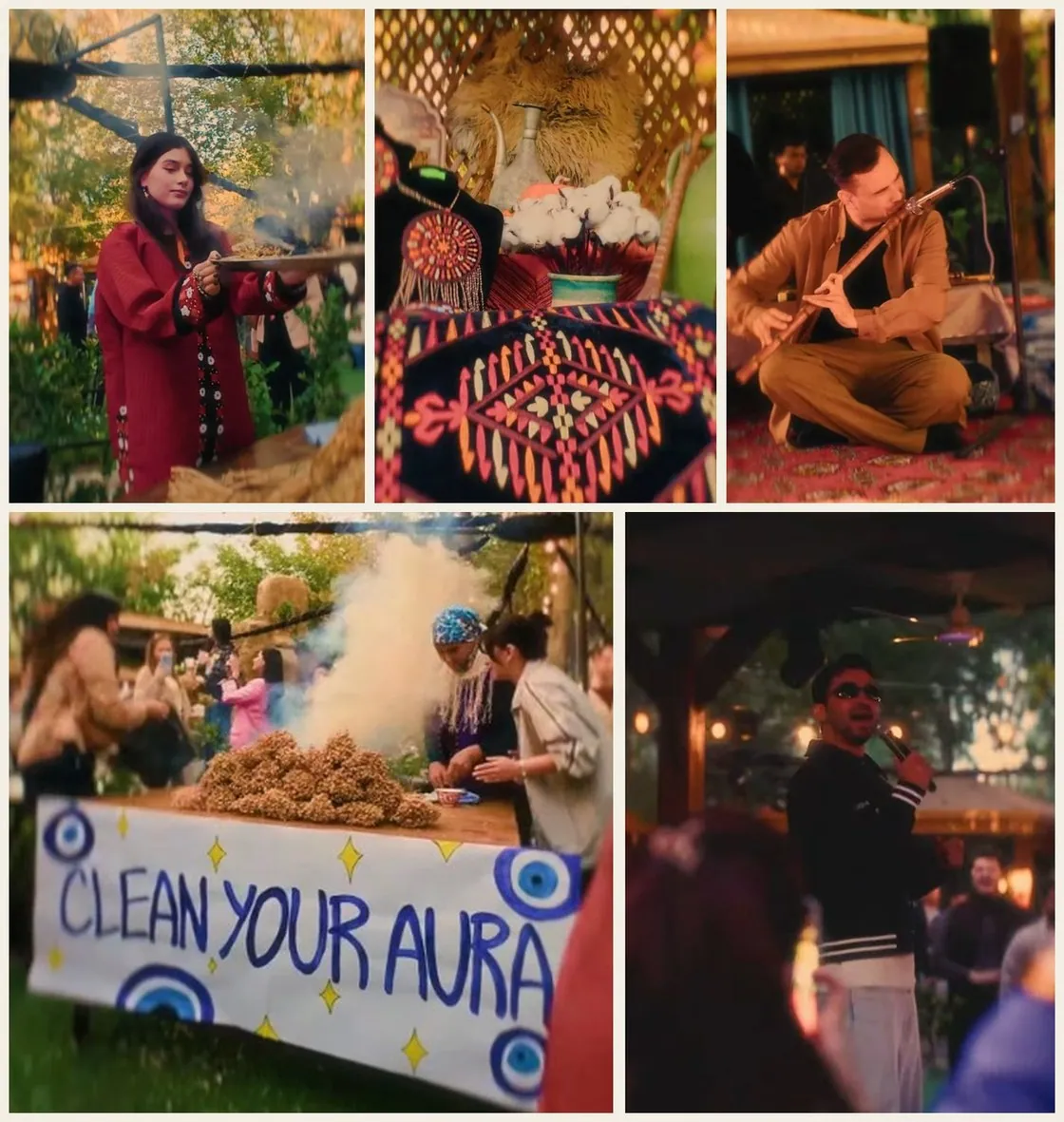
A toý without a couple. The photographs from the day show a young woman in a red embroidered dress carrying a smoking dish, a table of sheepskin, cotton bolls and embroidered textiles, a musician playing a long wooden flute cross-legged on a carpet, and a host with a microphone under strings of garden lights. One stall burned a heap of dried üzärlik, the wild rue (Peganum harmala) known in Russian as исирик, under a hand-painted banner that read, in English, "Clean Your Aura," framed with blue evil-eye symbols. Turkmen families burn üzärlik to ward off the evil eye, protect a home from bad luck, welcome guests or bless a new house and clear the air during ceremonies, so the stall put a household custom under a wellness slogan that would work at any festival abroad. The format has a close cousin abroad. Gulf News reported in 2025 that staged wedding parties with no bride or groom had spread from Delhi, Mumbai and Bengaluru to Dubai, with tickets from Rs 2,000 to Rs 15,000 and guests sorted into the bride's side and the groom's side for dance contests, games and a DJ. DÄP's version assigns the roles by bead and keeps the Turkmen toý at its center, but the idea is the same one party-goers in India and Dubai are buying tickets for: the music, food and dancing of a wedding, with no couple at the center.
A brand built on heritage. DÄP's own about page dates the brand to 2019 and its first capsule to T-shirts printed with illustrations of Turkmen customs and embroidered phrases, sold from a first showroom in the Berkarar mall. Earlier press gives other years: the Russian-language outlet WeProject reported in May 2020 that three Ashgabat entrepreneurs founded it in 2017 with a team of 14, and Turkmenportal has written 2018. The store list now runs to five outlets, four in Ashgabat and one at the Hotel Hazar in Avaza, plus an online shop and apps. The Urban capsule of September 2022 took white-marble Ashgabat as its theme, a "nostalgia" collection in February 2023 printed wall art from old city buildings and a wedding invitation from a family photo album on T-shirts, and the national football team wore DÄP kits at the first CAFA Nations Cup that June. The GOÇAK capsule of February 2025 names its colors in Turkmen: ülje, tüsse, ümür, köz and sary kişmiş.
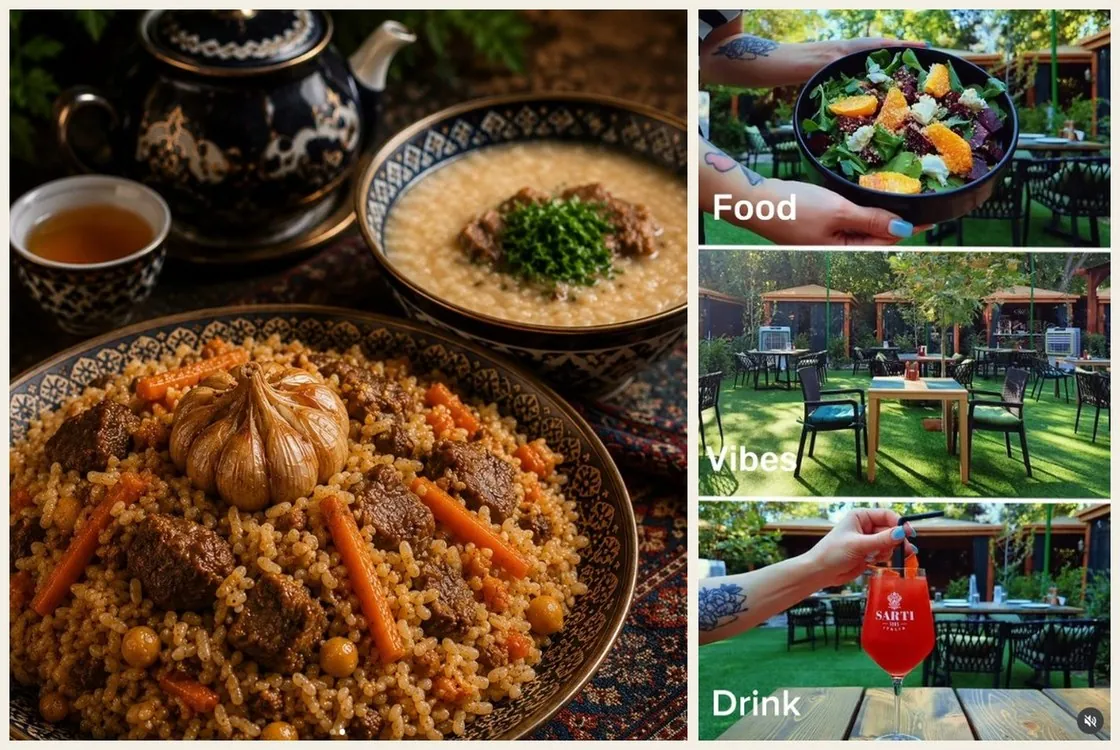
Food, vibes, drink. Aýlar, on Ata Gowşudow Street, is a garden restaurant with wooden pavilions on a lawn, and its menu runs from shashlyk, manty and gutap to salads and coffee. Its Instagram uses the reel format of café accounts worldwide: a clip split into "Food," "Vibes" and "Drink," with a beet and orange salad held up by a tattooed arm, the empty garden at golden hour and an Italian Sarti spritz, next to a styled spread of plov, a bowl of porridge and a black-and-gold teapot. Ashgabat's café culture is only a few years old by local accounts. SAIGA Tours, a tour operator that writes about the city, credited Sha Coffee in 2023 with starting the trend, quoting its founder, who had lived in London for a year: "why shouldn't Ashgabat have a cool café?" Turkmenportal profiled Ecodrink in April 2025 as a place for espresso, signature cocktails and pastries before work or study.
The rooms where it happens. The working end of this scene meets at the Ish Nokady coworking space. In November 2025, it hosted an International Start-up Forum run by UNDP and the Ministry of Communications, where more than 20 projects by young Turkmen entrepreneurs were shown. In December 2025, the Turkmenistan Urban Night Fest there brought together architect Ruslan Muradov, street photographer and filmmaker Erkin Yazov and digital artist Katalina Midyan, who spoke about building an ethnic-style brand with digital tools. In May 2026, the public organization Ýenme ran an AI Business Navigator series at which Resul Sopiev presented a chat assistant that works in Turkmen, and participants described using ChatGPT and Midjourney in their daily work.
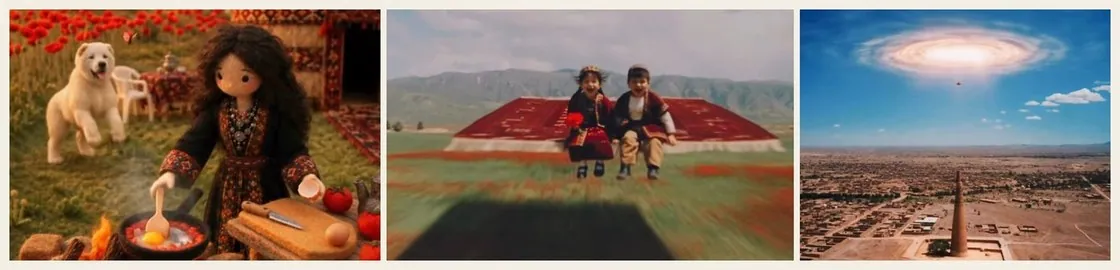
The screens. AI tools also turn up on sixtyonez, an Instagram account of AI-generated videos set in Turkmenistan. In one, a felted doll in a black embroidered dress and silver jewelry fries eggs and tomatoes over a fire outside a yurt. Behind her, a white puppy that looks very much like an alabay bounds through a field of poppies. In another, two children in Turkmen dress ride a red carpet low over a poppy meadow below the mountains, and a third sets a glowing vortex in the sky above an old brick minaret. The look is international: OpusClip, a video software company, lists AI "claymation" among the viral AI video styles of 2026, and the felted miniature is a close relative. The style is borrowed, and the material is Turkmen down to the dog. At home, the audience runs to hundreds of thousands: DataReportal's Digital 2026 report counts 3.53 million internet users in Turkmenistan, 46.1 percent of the population, and 388,000 social media user identities, the same figure as Instagram's advertising audience, though DataReportal cautions that ad reach is not a count of active users.
Fuels still made up 77 percent of Turkmenistan's merchandise exports in 2024, according to UNCTAD's profile. Alongside that economy, young Turkmen stage its own version of the parties, cafés, streetwear and AI videos its peers make in Dubai or Seoul, and names the result in Turkmen. The next date to watch is Türkmentel-2026 at the end of the year, when the Ministry of Communications announces the winners of its Sanly çözgüt (Digital Solution) 2026 competition, whose seven categories include AI, robotics and smart agriculture.
From the LinkedIn Feed
From the LinkedIn Feed
October ran on two tracks. Most of the month went to the first issue of Туркменоведение (Turkmenovedenie), the Soviet monthly printed in Ashgabat from 1927, which I am reading folio by folio. The other track carried four more carousels from my IFME session on Turkmenistan and the Middle Corridor.
The Turkmenovedenie series
Turkmenistan and the Middle Corridor, carousels 3 to 6

From the Desk
From the Desk
Published recently
Steppe Bridge Advisory LLC, 25 October 2026
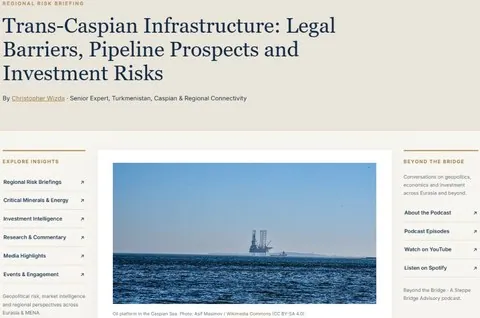
Trans-Caspian Infrastructure: Legal Barriers, Pipeline Prospects and Investment Risks
My regional risk briefing for Steppe Bridge looks at what still stands between Turkmen gas and European buyers: the rules on subsea pipelines, maritime delimitation on the Caspian, and the environmental and investment risks that sit around any crossing.
Trade Finance Global, 5 October 2026
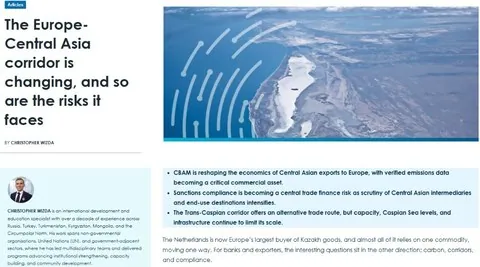
The Europe-Central Asia corridor is changing, and so are the risks it faces
This month's Trade Monitor takes the Kazakhstan-Netherlands trade, with oil going one way and manufactured goods the other, as its case. It covers the EU's Carbon Border Adjustment Mechanism, in its definitive phase since 1 January 2026, sanctions enforcement that now reaches regional intermediaries, a corridor that carried 4.12 million tonnes in 2025 against a falling Caspian, and renminbi bonds as a new channel for Central Asian borrowers.
Source Spotlight
Source Spotlight
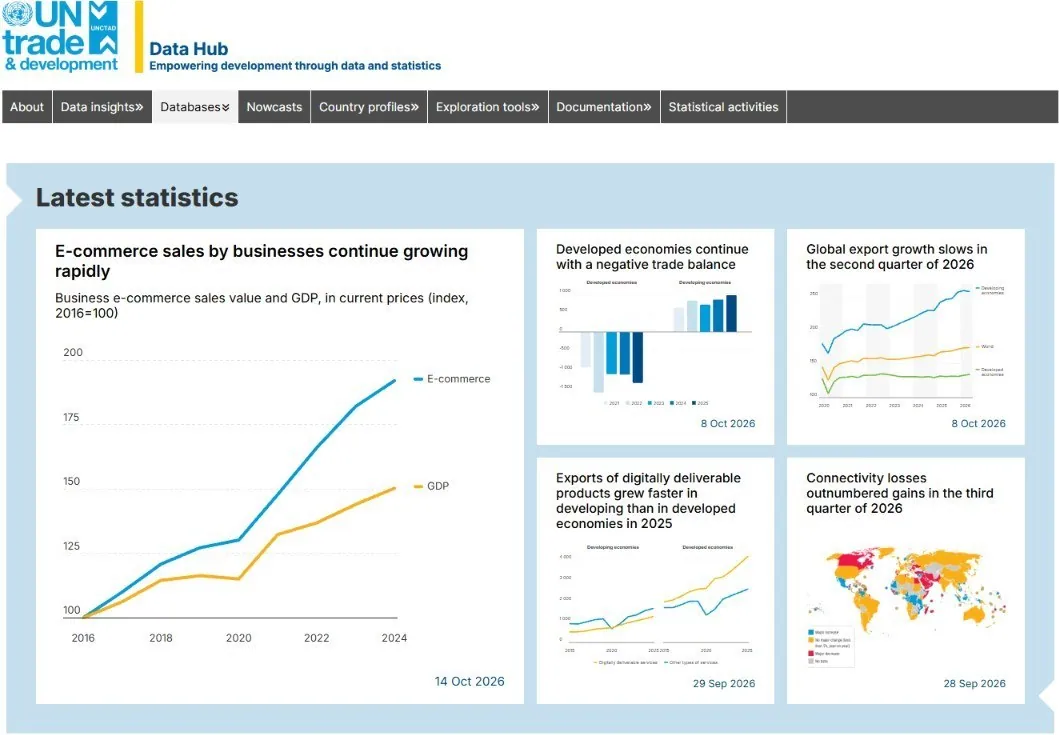
UNCTADstat, the UN Trade and Development Data Hub. UNCTAD's statistics portal is free, and its country profiles put a whole economy on two pages built from the same series for every country. I use them as a first check before a deeper pull from UN Comtrade or national data. The Turkmenistan general profile gives 7.494 million people, GDP of US$65.958 billion in current dollars, growth of 6.3 percent and an exchange rate of 3.5 manat to the dollar for 2024. Merchandise exports were US$12.371 billion against imports of US$3.834 billion, exports fell 14.3 percent on the year, and fuels made up 77 percent of them. China took US$7.139 billion, which by my arithmetic is about 58 percent, ahead of Türkiye at US$991 million and Uzbekistan at US$908 million.
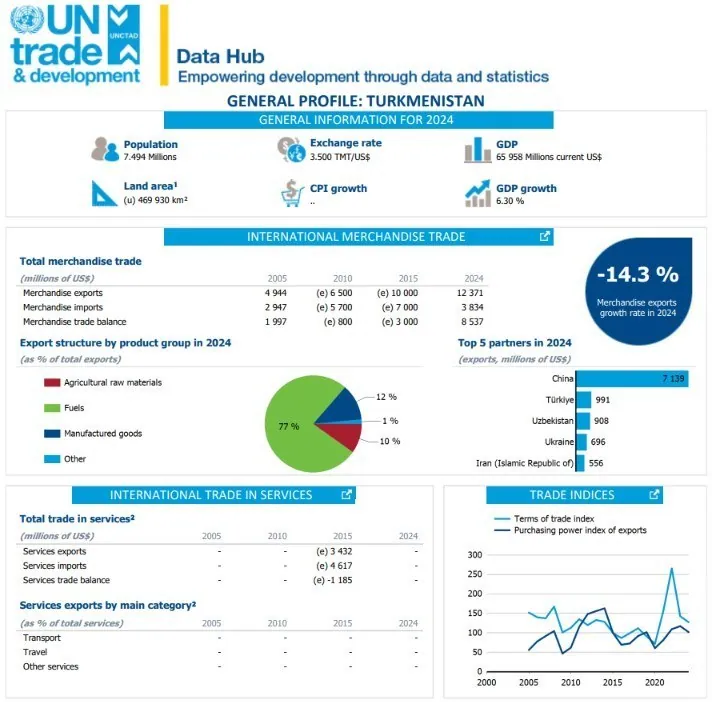
The profile is also honest about its own limits, which is the habit I value most in it. The 2010 and 2015 trade figures carry an (e) for estimate and the CPI growth field is left empty. Read it for the shape of the economy and check the partner figures against mirror data before you quote them. The Data Hub's about page explains the methods behind the series.
Methodology Bench
Methodology Bench
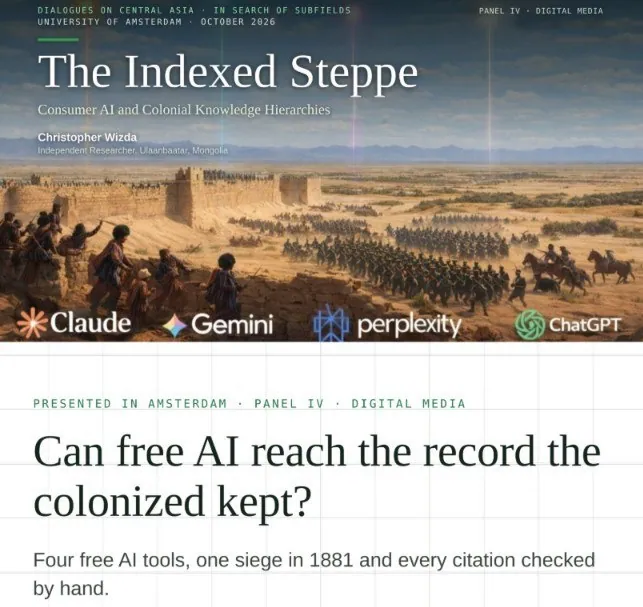
The Indexed Steppe: can free AI reach the record the colonized kept? In October, I presented "The Indexed Steppe" at Dialogues on Central Asia: In Search of Subfields at the University of Amsterdam, in Panel IV, Digital Media. The question behind it matters for anyone using AI in research on a region where the record is thin.
The talk turns on a story first printed in 1927. A Russian officer asked an old Teke man how many Turkmen had died at the walls of Gökdepe, the fortress Russian forces stormed in January 1881. He answered three, and when told the Russians had buried thousands, he did not revise his number. His answer refused the arithmetic altogether. So I asked whether the free versions of AI that people in the region actually use can reach the record the colonized kept, or only what the colonizer wrote down and the internet indexed.
To test it, I put one bounded case to the free tiers of Claude, ChatGPT, Perplexity and Gemini in June, with an anti-fabrication prompt and the same questions in English, Russian and Turkmen. Three of the four changed model or search access during the study, sometimes without notice. I then opened every citation by hand and checked spatial claims against satellite imagery.
The results tracked digitization more closely than difficulty. The Russian imperial military archive came back accurately reconstructed. The Turkmen lament, printed only in Russian translation, came back only as that mediated trace, and the undigitized oral and pre-1928 Arabic-script layer met silence or fabrication. One system failed integrity checks on 15 of its 24 citations, and two of those cite works that cannot be located at all. The most instructive failure was a link that resolved cleanly to the author's biography instead of the text it claimed to cite. These tools can succeed in tone while failing in substance, and fluency carries no information about accuracy. Nothing in that is specific to Turkmenistan, and wherever the archive is uneven across traditions, I would expect the same shape.
The talk closed on a routine any researcher can run:
- Verify every AI-surfaced citation against the original. A link that resolves is not a source that supports.
- Log the served model and web access for each query, across more than one system and language.
- Read an absence at the oral and minority-language floor as a finding. An honest null beats a fluent fill.
I am not rejecting AI. Research now often starts with a prompt instead of a library or a search engine, and the critical work we once did along the way now has to be done on purpose. If your archive has the same asymmetry, I would like to hear how these tools handle it.

Resources
Resources Desk
Country reports and briefings
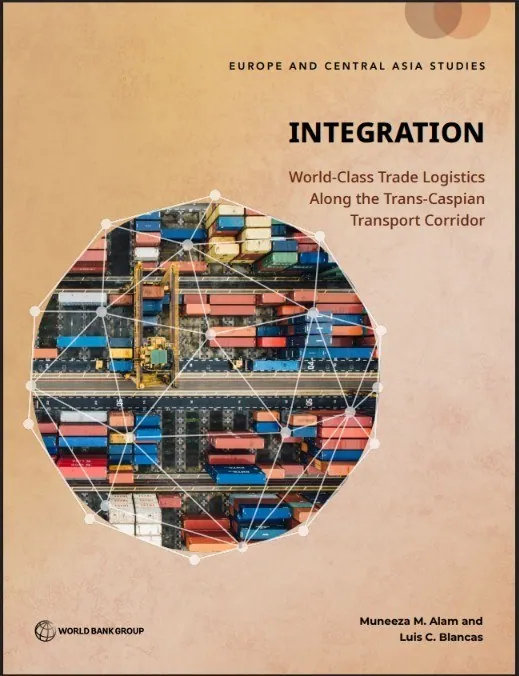
- World-Class Trade Logistics Along the Trans-Caspian Transport Corridor (World Bank, Europe and Central Asia Studies, by Muneeza M. Alam and Luis C. Blancas). The Bank's press release of 28 September 2026 puts the price of clearing the corridor's physical bottlenecks at no less than US$25 billion through 2040, with an estimated US$30 billion more for connecting roads and rail links, and estimates that the investment could more than triple trade volumes and halve travel times. Read the report page
- Green Hydrogen for Industrial Decarbonisation: Central Asia and the South Caucasus (IRENA, 2025). IRENA's 2025 study of where green hydrogen could replace fossil inputs in heavy industry across the two regions. Download the PDF
Datasets and tools
- UNCTADstat Data Hub. See this month's Source Spotlight. Open the Data Hub

Announcements
Announcements & Events
Upcoming.
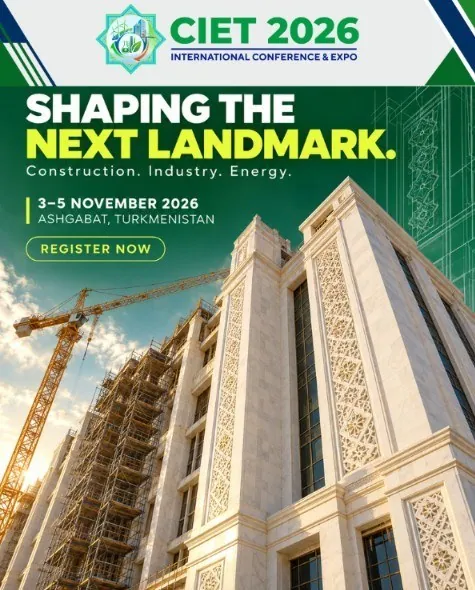
CIET 2026, Ashgabat, 3 to 5 November. The international conference and exhibition on the construction, industrial, chemical and energy sectors of Turkmenistan opens this week. Event notice
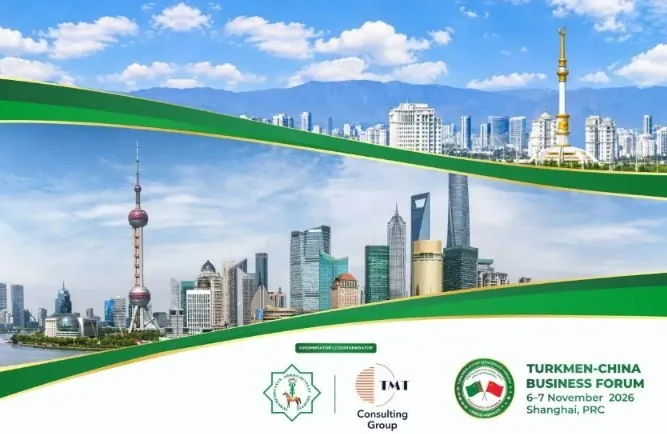
Turkmen-Chinese Business Forum, Shanghai, 6 to 7 November. The Chamber of Commerce and Industry of Turkmenistan and TMT Consulting Group are holding the forum in the same week as the 9th China International Import Expo, which runs in Shanghai from 5 to 10 November. Forum notice
Worth noting.
I have joined Steppe Bridge Advisory LLC as Senior Expert, Turkmenistan, Caspian and Regional Connectivity. Steppe Bridge is a boutique consulting and strategic intelligence firm that advises public and private clients on geopolitical risk and investment environments across Eurasia and the Middle East, with particular depth in Central Asia. My regional risk briefing on Trans-Caspian infrastructure is in From the Desk above. About Steppe Bridge

What to Watch
What to Watch
COP31 in Antalya, 9 to 20 November. Methane is the thread to follow. Türkmengaz and Türkmennebit have joined the UN's Oil and Gas Methane Partnership 2.0, which the EU's deputy head of delegation welcomed at a CAREC methane conference in Ashgabat on 29 to 30 October (turkmenistan.gov.tm, Russian).
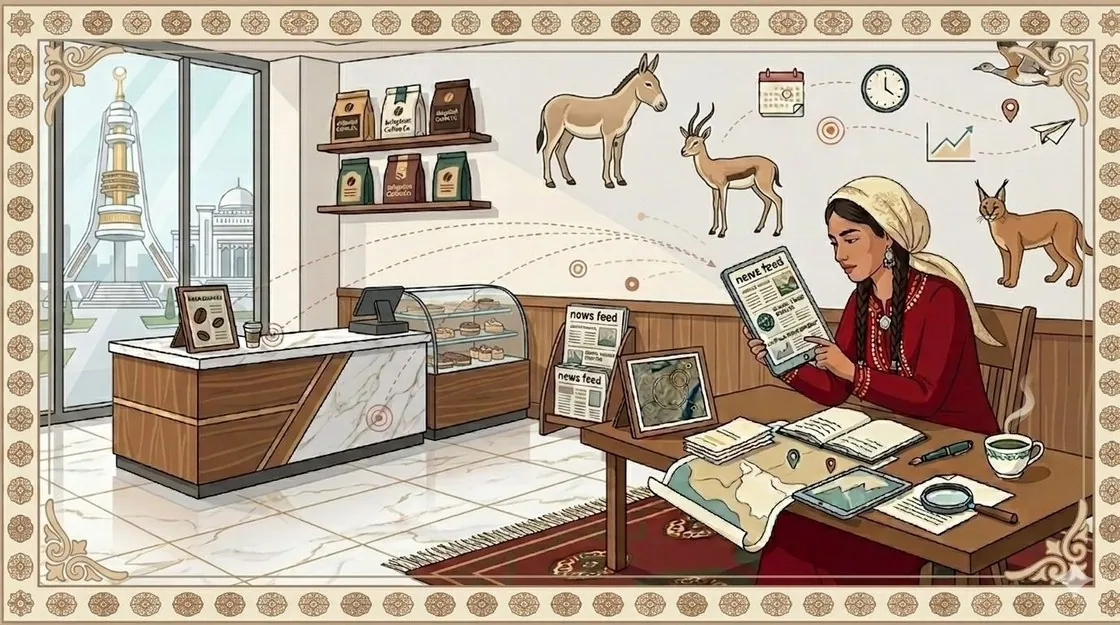
Türkmentel-2026 at the end of the year, where the Ministry of Communications announces the winners of its Sanly çözgüt 2026 competition in AI, robotics, smart agriculture and smart cities.
Neutrality Day, 12 December, the 31st anniversary of the UN General Assembly's recognition of Turkmenistan's permanent neutrality in 1995.
The 2027 motto. The Mejlis adopted the 2026 motto on 26 December 2025, so expect next year's in the last days of December.
TAPI's Herat section. As of 15 September, 122.3 km of the 153 km section had been welded and laid, with no gas sales contract yet signed (The Times of Central Asia), and the Taliban administration says the section will be ready by the end of 2026.
The Awaza follow-through in 2027. Watch for a first meeting date for the Uzbek-Turkmen Supreme Council, the Caspian joint commission's first session in Azerbaijan in the first half of the year and the CIS summit in Bukhara in October 2027.
Magtymguly
Magtymguly of the Month
Köňül ýatmaz hiç
(The Heart Never Settles)
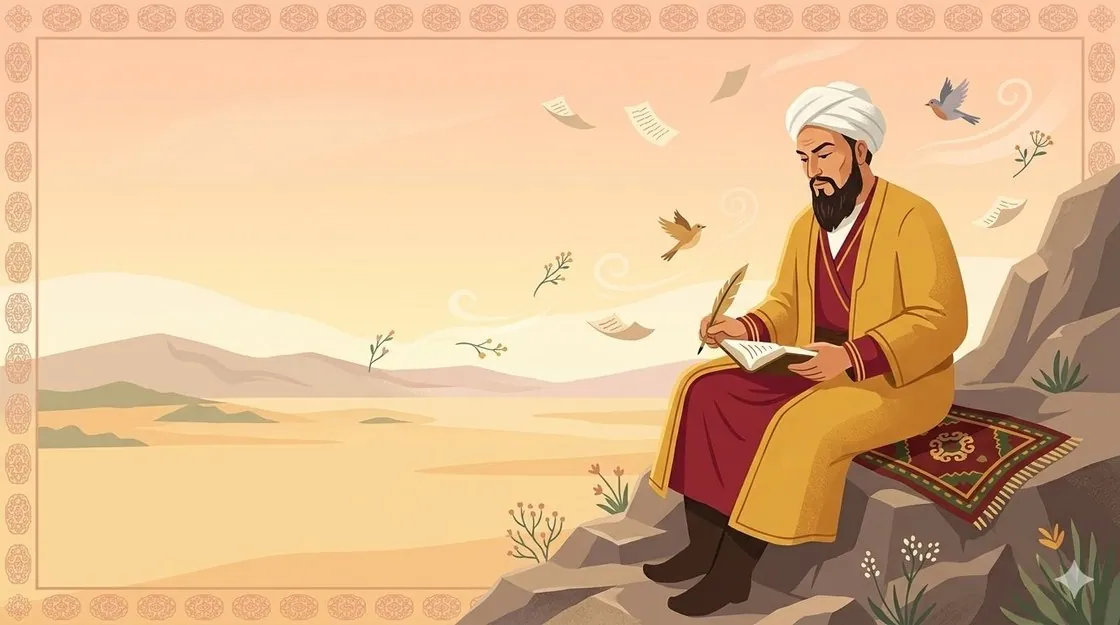
Why this one, this month. Köňül is the heart in its widest sense, the soul and the inner world of feeling. Ýatmaz means it does not lie down or sleep, and so does not settle, and hiç makes that never. Put together, the title says more than that someone cannot sleep: it names a heart that is restless with longing, love or a peace it cannot find. The poem closes by setting youth beside spring, good company and music, and by saying that the joyful days never seem enough, even if they last a hundred years. That restlessness runs through this edition. The young people in the Deep Dive staged a toý of their own, opened cafés and made videos out of their traditions because sitting still was not enough, and the dutar on the Däp Fest poster is the same instrument that has carried Magtymguly's verses for two and a half centuries.
Connect
Let’s talk
If you work in Central Asian policy, Caspian energy, Eurasian trade corridors, cultural and historical research, or regional analysis, or if something in this edition sparked an interest of your own, I would welcome the conversation. I am open to consulting, research and speaking engagements, as well as the right full-time opportunity, and I am especially keen to explore fellowships, part-time lecturing and research roles.
Interested in more? For weekly posts on Turkmenistan and the broader Caspian and Central Asian region, connect with me on LinkedIn. If you haven't already, subscribe to The Karakum Brief, my monthly LinkedIn newsletter on Turkmenistan, the Caspian region and Central Asia, grounded in field experience and Russian and Turkmen language sources. Past editions are at christopherwizda.com.
If you would like to feature this edition, or parts of it, in your publication, I am open to collaboration, including writing on other topics for your audience.